


Gartner คาดตลาดเซมิคอนดักเตอร์โลกปี 2569 โต 92% แตะ 1.6 ล้านล้านดอลลาร์ โดยชิป Memory ครองรายได้ 54% รับการลงทุน AI Data Center
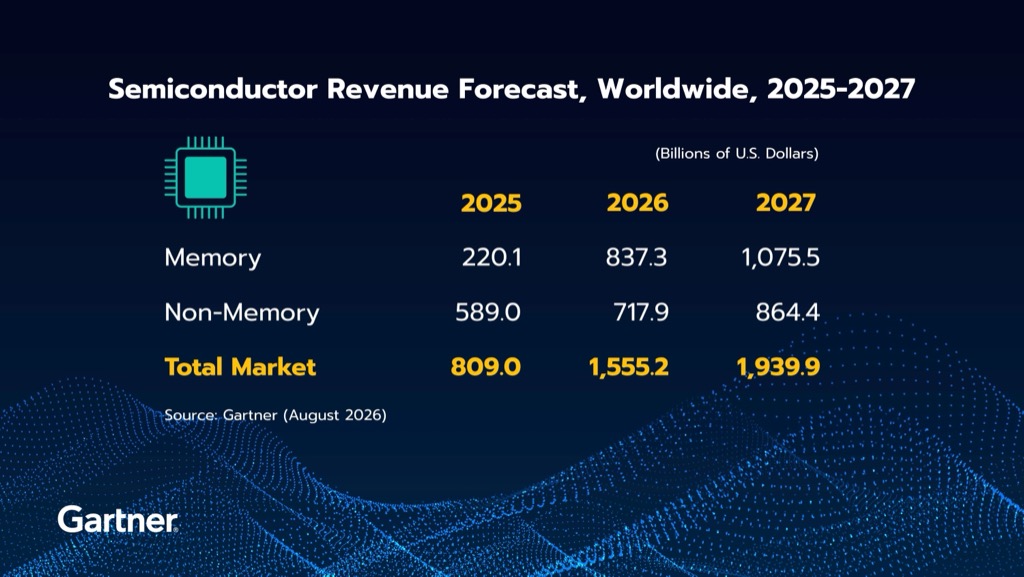
การ์ทเนอร์ อิงก์ บริษัทวิจัยและให้คำปรึกษาชั้นนำด้านเทคโนโลยีและธุรกิจ คาดการณ์รายได้เซมิคอนดักเตอร์ทั่วโลกในปี 2569 จะพุ่งสูงถึง 1.6 ล้านล้านดอลลาร์สหรัฐฯ เติบโตเพิ่ม 92% เมื่อเทียบกับปีก่อนหน้า ที่มีรายได้รวมอยู่ 809 พันล้านดอลลาร์สหรัฐฯ และคาดว่ามูลค่าตลาดในปี 2570 จะขยับขึ้นไปแตะ 1.9 ล้านล้านดอลลาร์สหรัฐฯ
เบน ลี ผู้อำนวยการฝ่ายวิเคราะห์การ์ทเนอร์ กล่าวว่า “อุตสาหกรรมเซมิคอนดักเตอร์กำลังเดินไปสู่ระลอกการเติบโตครั้งใหม่ โดยอุตสาหกรรมนี้มีอัตราการขยายตัวเพิ่มขึ้นอย่างรวดเร็ว เป็นผลมาจากการลงทุนในโครงสร้างพื้นฐาน AI ที่เติบโตต่อเนื่อง ควบคู่กับราคาชิปหน่วยความจำที่ปรับตัวแข็งแกร่งเกินคาดตามรอบวัฏจักร”
“การขยายตัวของโครงสร้างพื้นฐาน AI ไม่เพียงแต่ก่อให้เกิดการจัดสรรเม็ดเงินลงทุนใหม่ทั่วทั้งระบบนิเวศเซมิคอนดักเตอร์ แต่ยังเข้ามากำหนดนิยามใหม่ของส่วนผสมการใช้งานในอุตสาหกรรมอย่างมีนัยสำคัญ โดยคาดว่าระบบนิเวศ AI Data Center จะมีสัดส่วนรายได้เติบโตจาก 36.5% ของรายได้เซมิคอนดักเตอร์ทั้งหมดในปีนี้ ขึ้นไปมากกว่า 53% ภายใน 4 ปีข้างหน้านี้ (พ.ศ. 2573) ตอกย้ำถึงการเปลี่ยนแปลงเชิงโครงสร้างของการสร้างมูลค่าและความต้องการชิปทั่วโลก”
การ์ทเนอร์คาดว่ารายได้จากกลุ่มชิปหน่วยความจำ (Memory) ในปีนี้ จะอยู่ที่ 837 พันล้านดอลลาร์สหรัฐฯ และปีหน้าจะเพิ่มกว่า 1 ล้านล้านดอลลาร์สหรัฐฯ
โดยชิปกลุ่ม Memory ยังเป็นฟันเฟืองสำคัญขับเคลื่อนอุตสาหกรรมเซมิคอนดักเตอร์ในปีนี้ และครองสัดส่วนรายได้เกินครึ่ง (54%) ของรายได้รวมทั้งหมด ขยับขึ้นมาจาก 27% ในปี 2568 (ตามตารางที่ 1)
ตารางที่ 1: คาดการณ์รายได้อุตสาหกรรมเซมิคอนดักเตอร์ทั่วโลก ปี 2568-2570 (หน่วย: พันล้านดอลลาร์สหรัฐ)
| 2568 | 2569 | 2570 | |
| Memory | 220.1 | 837.3 | 1,075.5 |
| Nonmemory | 589.0 | 717.9 | 864.4 |
| Total Market | 809.0 | 1,555.2 | 1,939.9 |
ที่มา: การ์ทเนอร์ (สิงหาคม 2569)
ปีนี้ คาดว่ารายได้ชิป DRAM จะพุ่งขึ้นถึง 246.6% ขณะที่หน่วยความจำ NAND flash จะเติบโตสูงถึง 371.9% แม้ในปีหน้า (2570) จะมีกำลังการผลิตใหม่เข้ามาสู่ตลาดเพิ่มขึ้น แต่สภาวะอุปสงค์และอุปทานจะยังคงตึงตัว เนื่องจากการใช้งานโครงสร้างพื้นฐาน AI ยังคงเพิ่มปริมาณการใช้ชิปหน่วยความจำอย่างต่อเนื่อง
คุณชริช พานต์ (Shrish Pant) ผู้อำนวยการฝ่ายวิเคราะห์การ์ทเนอร์อีกท่าน กล่าวเสริมว่า “โครงสร้างพื้นฐาน AI ได้เข้ามาเปลี่ยนแปลงความไดนามิกของตลาดชิป Memory ไปอย่างสิ้นเชิง แม้การปรับตัวขึ้นของราคาชิปจะเป็นปัจจัยเร่งการเติบโตในปีนี้ แต่การลงทุนสร้างโครงสร้างพื้นฐาน AI การเพิ่มปริมาณความจุหน่วยความจำต่อ AI Server รวมถึงความต้องการชิป High-Bandwidth Memory (HBM) ที่แข็งแกร่งต่อเนื่อง จะเป็นแรงหนุนสำคัญให้รายได้กลุ่ม Memory เติบโตอย่างมั่นคงในระยะยาวไปจนถึงปี 2570 และหลังจากนั้น”
โครงสร้างพื้นฐาน AI กระตุ้นตลาด Non-Memory เติบโตร่วมด้วย
เมื่อระบบ AI Clusters มีขนาดใหญ่ขึ้น รวดเร็วขึ้น และบริโภคพลังงานสูงขึ้น จึงจำเป็นต้องมีการลงทุนเพิ่มในส่วนประกอบอื่น ๆ ไม่ว่าจะเป็นชิป CPU, ชิป Networking Silicon, อุปกรณ์จัดการพลังงาน (Power Management), อุปกรณ์อนาล็อก (Analog Devices) และเทคโนโลยีการเชื่อมต่อด้วยแสง (Optical Interconnect)
“AI ขยายโอกาสทางธุรกิจให้กับอุตสาหกรรมเซมิคอนดักเตอร์ ครอบคลุมทุกระดับชั้นของโครงสร้างพื้นฐาน ไม่ได้กระจุกตัวอยู่แค่ชิปประเภทใดประเภทหนึ่งเท่านั้น โดยการ์ทเนอร์คาดการณ์ว่าหากไม่นับรวมกลุ่มชิป Memory รายได้ชิปกลุ่ม Non-memory จะเติบโตจาก 589 พันล้านดอลลาร์สหรัฐฯ ในปี 2568 ขึ้นไปเป็น 718 พันล้านดอลลาร์สหรัฐฯ ในปีนี้ เติบโต 21.9% และพุ่งแตะ 864 พันล้านดอลลาร์ในปี 2570” คุณเบน ลี กล่าวปิดท้าย
Gartner Forecasts Global Semiconductor Revenue to Surge 92% to $1.6 Trillion in 2026
Gartner forecasts global semiconductor revenue to rise 92% year over year to approximately $1.56 trillion in 2026, before expanding further to around $1.94 trillion in 2027. Growing investment in AI infrastructure and stronger memory chip prices are expected to be the main drivers.
Ben Lee, Senior Principal Analyst at Gartner, said the semiconductor industry is entering a new growth cycle as investment in AI infrastructure continues to accelerate alongside stronger-than-expected memory pricing.
The industry’s revenue mix is also shifting with the expansion of AI data centers. Gartner expects the AI data center ecosystem’s share of total semiconductor revenue to increase from 36.5% in 2026 to more than 53% by 2030, reflecting a structural change in global chip demand and value creation.
Memory is expected to deliver the strongest growth. Revenue from the segment is forecast to reach approximately $837.3 billion in 2026, accounting for 54% of the total market, up from 27% in 2025. Memory revenue is then projected to exceed $1 trillion and reach around $1.08 trillion in 2027.
By category, DRAM revenue is expected to increase by 246.6% in 2026, while NAND flash revenue is projected to grow by 371.9%. Although new production capacity is scheduled to enter the market in 2027, Gartner expects supply and demand conditions to remain tight as AI infrastructure continues to consume greater volumes of memory.
“While higher memory pricing is accelerating growth this year, investment in AI infrastructure, rising memory capacity per AI server and sustained demand for High-Bandwidth Memory will provide long-term support for the memory market through 2027 and beyond,” said Shrish Pant, Senior Principal Analyst at Gartner.
The growth is also extending into the non-memory segment. As AI clusters become larger, faster and more power-intensive, they require additional CPUs, networking silicon, power-management components, analog devices and optical interconnect technologies.
Non-memory semiconductor revenue is forecast to increase from $589 billion in 2025 to $717.9 billion in 2026, representing growth of 21.9%, before reaching $864.4 billion in 2027.
The figures indicate that AI is increasing semiconductor demand across the entire infrastructure stack, spanning processors, networking, memory, power management and data center interconnect technologies.